Posts tagged with “mathematics”
Graph sketching
Oh god, I’m going to talk about maths for a bit. Ignore me. You might find this interesting if you know what a derivative is and what it means.
This is a curiosity that my friend Anupam came up with. I’m not claiming any credit for noticing it but I thought I’d still share it with y’all. It only requires very rudimentary calculus, but it produces a result which, the more I think about it, the less intuitive it seems.
Daydreaming
This comic has been pinned up in my lab for a while, I love it.
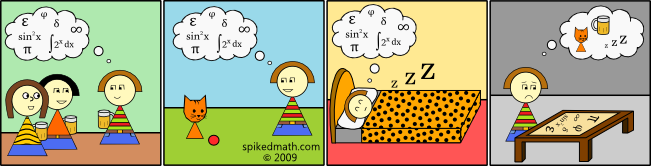
Via spikedmath.com.
Variable names fail/win
This is a good paper but the choices of variable names are making me sad :(

Ah well... at least sometimes variable names lead to happy consequences. This is from the same paper:
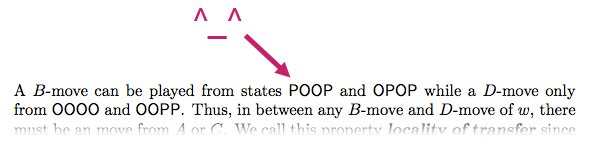
"Designing to reveal the nature of the universe" — Jonathan Blow and Marc ten Bosch at IndieCade 2011
Note
Jonathan Blow has said some truly embarrassing stuff since I made this post. At original time of writing, I was a fan. Now, I’m just disappointed.
I watched this interesting talk on game design by Jonathan “Braid” Blow and Marc “Miegakure” ten Bosch. They espouse and explore a particular design aesthetic where the designer essentially plays the role of a mathematician. “Good design” then becomes a selection of orthogonal mechanisms (axioms), and an exhaustive-yet-minimal mapping-out of what’s derivable (theorems), and then demarcation of the boundary. Since it needs to be fun, the real art has to come from crafting surprise and tweaking axioms to capture exactly what you want. They both make some very interesting points, and I thought this comparison with mathematics was a particularly cool and apt way to frame the ideas.
This aesthetic is particularly apparent in the examples they use in the talk, including Braid, VVVVVV, Ikaruga and the as-yet-unreleased Miegakure.
Academic site
I now have a home page over at the University of Bath, where I’m doing my PhD. It’s just for academic things and lists of publications. Find it here: cs.bath.ac.uk/~cajw20.
Maths how does it work

MFPS 28

Here’s what I’m doing this week: the 28th annual Mathematical Foundations of Programming Semantics conference. I am presenting a paper there, “A graphical foundation for schedules”, joint work with my PhD supervisors Guy McCusker and John Power. There’s a preliminary version of the paper which will eventually appear in ENTCS. The talk had slides, though they contained unnecessary illustrative animations which are not there on the pdf.
Workshop on Algebra, Coalgebra and Topology
I’m a local organiser for the Workshop on Algebra, Coalgebra and Topology (part of the Wessex Theory Seminar) which will be held at the University of Bath on March 1st 2013. More details on that page to which I just linked. Email me if you’d like to attend (registration is free). Proceedings will be published in ENTCS if enough people submit.
Life in Life
Conway’s Game of Life is a well-known cellular automaton in which, every tick, the state of each of the cells on a giant grid is determined only by the states of its immediate neighbours in the previous tick. Despite its extremely simple definition, it is famously Turing-complete, which is roughly to say that it can compute any computable function.
And so, of course, someone has written a Life emulator, in Life.
Perhaps it’s Life all the way down...
Magic the gathering is Turing-complete
I just mentioned Conway’s Game of Life as an example of a Turing-complete system.
Though it’s called the “Game” of Life, and some people describe it as a zero-player game, it’s not really a game in the traditional sense of the word.

For an unexpected example of an unambiguous game which is also Turing-complete, check out Magic: The Gathering. It has been shown that a Universal Turing machine can be constructed inside Magic, and hence that it is Turing-complete.
I played a lot of Magic in high school, though it’s too expensive of a habit to keep up for long. If, like me, you remember Magic fondly, but don’t play it so much any more, might I recommend Mark Rosewater’s Drive to Work podcast?
Parable of the Polygons
Hey, just look at this! It’s a completely beautiful thing!

Twelve Tones
A while ago, Vi Hart (who I’ve mentioned before here as an author of the cool interactive essay Parable of the Polygons) made this fantastic short film about mathematics, meaning and music.
It’s really something special.
Vi Hart is probably the best
Vi Hart (who you may recall, I think is amazing) originally became known (to me) by her “doodling in math class” series of short films.
"Have one fewer child"
I’ve been looking for suggestions of individual actions one can take to reduce CO2 emissions. In particular, ones which actually make a big difference (unlike, e.g., switching to LED lightbulbs). Everywhere I look, all I see is “have one fewer child” dwarfing all other actions by effectiveness. It’s all anyone talks about.
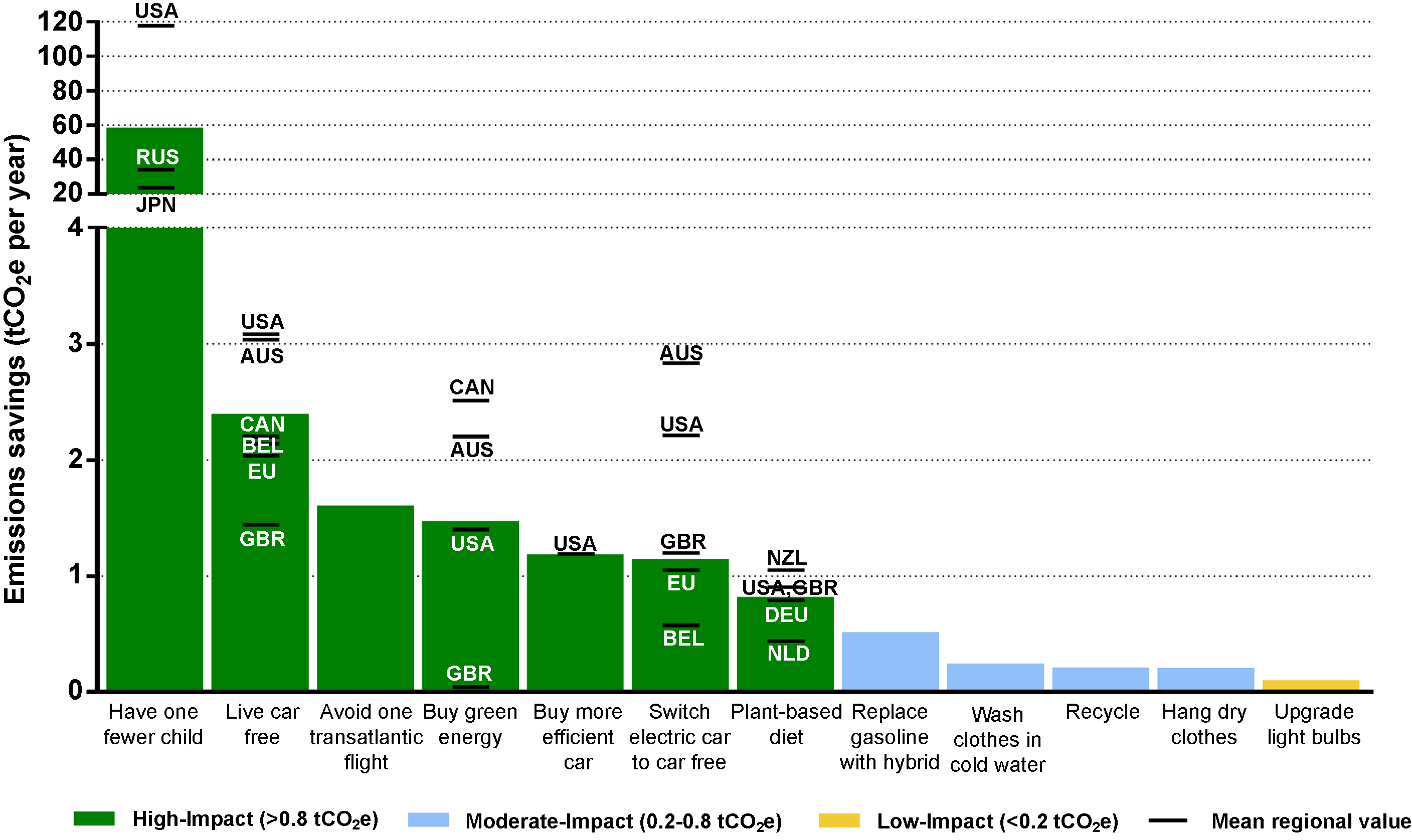
The Web is full of figures like this one. It shows the one-fewer-child recommendation being equivalent to about 60 t/y, where the next-best options like “sell your cars”, “stop flying” or “be vegan” are mostly in the 1–2 t/y range. So high, they had to clip and compress the range on the graph so you could even see anything else. That looks pretty stark. That figure is so high, it seems as if nobody could ever hope live sustainably if they had even one child. They might as well be taking a long-haul flight every 10 days for the rest of their life! Now, we definitely shouldn’t discount conclusions just because they are surprising or uncomfortable, but we should scrutinise them. That feeling of “…really?” is the first hint something might not be right.
Newton's Fractal
Grant Sanderson aka 3blue1brown has a wonderful channel on Youtube where he creates accessible yet deep educational maths videos. The are literally all very good, but the last two are a really great introduction to a topic in fractal geometry, and a demystification of the Mandelbrot set, presented with supreme clarity and fantastic visualisations. Probably requires high-school or first-year undergrad maths to really understand the technical content, but if you have interest in the topic I think you would get a lot out of this even if you have no formal education.